Friday, May 13, 2011

Traditional Afghan Clothing

What do you associate with the word Afghanistan?

Many probably will picture of a war, terrorists, Islam and Osama Bin Laden.

But have you ever took time to see the bright side of Afghanistan?

Despite the dark image of its reputation, Afghanistan's traditional clothes are colorful!

They have such a beautiful complexion of dresses which are mostly for women. Because of embroideries on clothes and gorgeous motif, it reminds me of Saree, Indian clothing, in some ways.

Afghanistan has been known for its struggles due to constant wars and a negative portray as a home for terrorists.

However, it has its own cultural beauty and legacy. I presume that to the eyes of many, Afghanistan is unfortunately not famous for its some of delightful traditions.

So I'd like to introduce a part of their culture!

I found these pictures of dresses from the website Zarines.com. Their beauty is beyond words.

I hope this would be an opportunity for all of us to get to know a positive side of Afghanistan that we hardly see in the media.

Afghan Children :)                                                                                    Shala
                      
                                                 Najila                                                                                                                                                                   
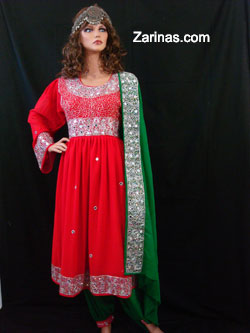
Palwasha                                                                                                                                                       
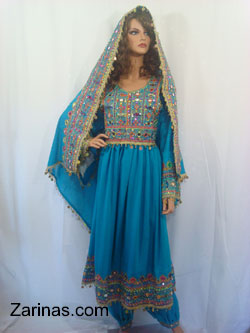
Zainab                                                                                                                                                          
Mastana                                                                                                                                                        


Afghan Clothes  


                                                          Afghan Women Clothing 2011

Tuesday, May 10, 2011

Indian make up: Bindi

Bindi is a decoration on the forehead that is worn in Southern Asian countries like India, Nepal, and Sri Lanka.

Any gender and age of people wear it. Some people who converted to Hinduism wear it as well.

A red dot that most people might be familiar with is a sign of marriage among women.

Bindi is believed to strengthen concentration and maintain energy.

The significance of Bindi is that the central area between eyebrows is meant to be the Hindu wisdom.

Red dot is also a sign of love. It's supposed to attract a lover.

It is another beautiful legacy of Hinduism and India.

                                                                             Bindi

                                                                 Bindis in intricate designs. 
 Natalie Portman wearing Bindi while shooting the next film, "New York, I Love You."

Monday, May 9, 2011

International Edition: Hijab

Fashions identify one's social heritage, cultural background, and sometimes economic status.

Fashion also plays a role of self-expression whereas traditional clothes are more likely to expresses one's faiths.

For this week's edition, I'd like to explore another cultural beauty: Islamic fashion. When I think of an Islamic fashion, I immediately picture Thawb and Hijab

Hijab is the headscarf commonly worn by Muslim women to cover their heads and necks; the word Hijab in Arabic literary means "covering up." In countries like Saudi Arabia, women wear Abayah which covers the body from shoulders to feet. In other countries like Iraq, Syria, Jordan and Lebanon, women would wear a mixture of either Hijab, Abayah or casual jeans, shorts, and skirts. 

In a similar vein, some Muslim men can be seen in western clothes or their traditional dress called Thawb. Thawb is common especially in Persian Gulf states like Oman, Qatar and Kuwait.

The term Thawb is also implied to long, over-sized woman's garment; its front is embroidered. Typically made of cotton, wool is sometimes used in Thawb for colder seasons. 

Hijab as well as Abayah represent a beauty and a modesty of Islam. It is a symbol of faiths. There has been an unfavored perception in the western world failing to understand the meaning of them.

Putting on coverings like Hijab is a sign of honor and equality with men. By concealing the body, it provides a security from unwanted eyes by men.

Moreover, it is another way of paying a respect to their faiths according to the holly book of Islam, Quran.

However, there is an ongoing debate about Hijab among Muslim women, too. They argue that it is a matter of choice whether or not they dress in Hijab. 

Those Muslim women who I met were from Saudi Arabia and Kuwait. They mix an Islamic style and a western style together. I find  it as a beautiful combination of two cultures. Some are wearing fashionable Hijabs that come in different colors like pink, blue, and purple. Interestingly, Hijab appears to be well on casual clothes.  

The way they wrap Hijab seems like an art. Steps to wrap Hijab are as follow:

Step 1: Place the scarf over the head with leaving one side of it longer than the other side. 

Step 2: Fold up the scarf behind the neck, and pin the two edges together. 

Step 3: Bring the longer side of the scarf to the chin. Then keep wrapping it around to the opposite side.

Step 4: Make an adjustment so that both sides of the scarf will fall equally.

Step 5: Lastly, pin the top of the scarf until the part of the neck.

Above is just one of many styles of wearing a Hijab. For more, there is a number of tutorial videos on Youtube, so enjoy learning a significance of Islamic culture!

There certainly has been a controversy surrounding Islamic dresses. But before all else, if you encounter an opportunity to look at them physically, may you find their cultural legacy just like your own.

Why Muslim women wear the veil 


From Muslimah Media Watch

Coverage of "Fashionable" Muslim women cramps our style


Hijab


Thawb


                                                                                Abaya Fashion Show in Dubai


Saturday, May 7, 2011

Was the reaction of cheering crowd over Osama Bin Laden's death appropriate?

It was on Sunday night, when my friends' facebook status caught my eyes by posting, "Good Riddance, Osama Bin Laden."

The status struck me, yet gave me a question mark that if he is dead for real, so I immediately googled his name.

If I remember correctly, I went on to the website with heading that said, "CNN reports that Osama Bin Laden is dead, May 1, 2011. President Obama to make an announcement at 10:50 p.m. US ET ..."

Still not fully convinced, I shouted my roommate's name after reading an aritcle and acquainted breaking news as if I have seen something startling.

My certainty was up in the air.

Half an hour passed since I read my friend's facebook status. More of my friends started posting status related to death of Osama Bin Laden. They all reacted in the same way - Jubilant.

Though facebook doesn't reveal the tone of voice nor a facial expression, their joyousness over his death was obvious.

When the time for President Obama's announcement came around, my roommate and I sat in front of the computer screen to listen to his speech on live.

My doubts about Bin Laden's death gradually disappeared as the President provided a further confirmation.

"Justice has been done," President Obama spoke to viewers in a flat calm voice.

Soon after his announcement, the broadcast of a vast crowd in front of the white house began. 

Even though I finally acknowledged the incident, I wasn't as happy as those who chanted the operation of killing the world's most wanted man.

Is there really justice in killing? Is cheering the death of someone acceptable?

If they legitimatize their cheering reaction, how could they argue about Al-Qaeda including Bin Laden himself, who cheered on 9/11? 

Indeed Osama bin Laden was a murderer. I don't deny that. He killed countless number of our human brothers.

President's proclamation of justice didn't gratify me and neither the reaction of many who cheered on Bin Laden's death. I watched the live video of them shouting together, "F*** you Osama!, F*** you Osama!" in front of the white house thinking that it was not a matured behavior.

Perhaps if I was the victim of 9/11, I may have showed the same expression as they did.

Nevertheless, I believe that praising an action of killing regardless of who is a prime example of bigotry thus falling into the same category of what Bin Laden has done.

At this point, I'm not sure whether or not he deserved death, but it is not hatred that defends us.

Being proud of bringing down anyone is not grateful.  


For more I recommend reading the article below.


As I was blogging this, I thought of  Mahatma Gandhi's quotes.

"Through violence, you may kill a liar, but you can't kill the lie."

"They may torture my body, break my bones, even kill me. Then they will have my dead body, but not my obedience."


Thank you all.

Sunday, May 1, 2011

International Edition: Saree and Henna

India; it is a beauty of culture, food, languages, diversity and civilization. Although I've never explored India in my entire life, I've always been fascinated by its mystical yet mesmerizing culture. Perhaps it's because of my partial identity. Yes, I've got Indian blood in my vein!

In relation to a previous column, I'd like to present an Indian traditional clothes Saree and the body art called Henna.
Henna


Though western fashion can be seen in cities like New Delhi, the capital of India, many still wear saree as everyday clothes. In fact it's been worn for the past thousand years ever since Indus Vally Civilization.

Saree, sometimes spelled sari, is popular in Southern Asian countries like Nepal, Bangladesh and Malaysia. The word sari comes from Sanskrit meaning 'strip of cloth.' The length ranges from four to nine meters, and it's draped over the body in different styles. It's worn over an undergarment with a blouse called Choli composing upper garment.


India has a diverse culture and so is Saree's dressing style. Each region has its own style, but the most common style is wrapped around waist with one end draped over the shoulder. While the majority of women wear cotton made Saree, wealthy women wear silk ones. Younger generation of women choose bright colors. In terms of design, there is a countless number of saree. Some have beads with only one color of garment. Some have two to three colors with beautiful motif. Different collection of sarees are satin saree, silk saree and chiffon Saree.


Another attractive traditions is Henna, sometimes known as Mehndi, which is a popular body art in India. It's been used to dye hair, skin, fingernails, and so on. Henna lasts about one to four weeks, so it's like a temporary tattoo.

Henna was originally used way back in ancient Egypt to stain fingers and toes for mummification of Pharaohs.
In Indian culture, Henna is commonly used for wedding ceremonies.

When I tried Henna, the paste smelled like medicinal herb that somehow it soothed me. And it didn't hurt like a permanent tatto! I used Henna that came in a small tube. If you want to try out Henna, here are some tips.


1. Draw whatever design your heart desires on the hands or on the feet. (In fact you can print Henna on any part of the body and I personally like drawing floral design.) Use your own creativity!

2. After henna is applied, wait for about 15 to 20 minutes.

3. Scrape the paste off when it gets dried out completely.

4. Wash your hands with soap. However, do not wash the area of applied paste on your hands early, because the earlier you wash them, the lighter Henna appears to be.

5. Then there you have it, a beautiful Henna tattoo!

Though there is a minor controversy, I have to warn you about black henna. According to Health Canada, PPD (paraphenylenediamine) which is added in black henna may cause a damage to skin. Meanwhile Red Henna is considered safer, so I recommend using it instead.

Rich in culture and heritage, India enchants the eyes and the minds of many. In that respect, I introduced only a glimpse of its legacy. Either way, I'm certain India will keep captivating the hearts of others.


India Gallery


Saree in Colors

Delicious Indian Food

Indian Elephant

Festival of Light Diwali

Endangered Species Bengal Tiger

Monday, April 25, 2011

Potential Fashionista Column: India :D


Although I've never seen with my own eyes, I've always had an adoration towards my other heritage India. I've been fascinated by its cultural beauty, countless languages that are spoken among Indian people, diversity of each region, and, of course, delicious Indian food!

I'd like to take my column as an opportunity to explore a part of my roots, India, by introducing Saree which is a traditional clothes and Henna (Mehndi) which is a temporary tattoo made of flowering plants.

And I hope my next column will be enjoyed by as many readers as possible. Thanks! ;)
                                                           
                                                               Body Art Mehndi (Henna)


                                                                                               Wedding Dress


                                                                                Bollywood Start Rai Aishwarya

                                      
                                                                              India's traditional clothes: Saree